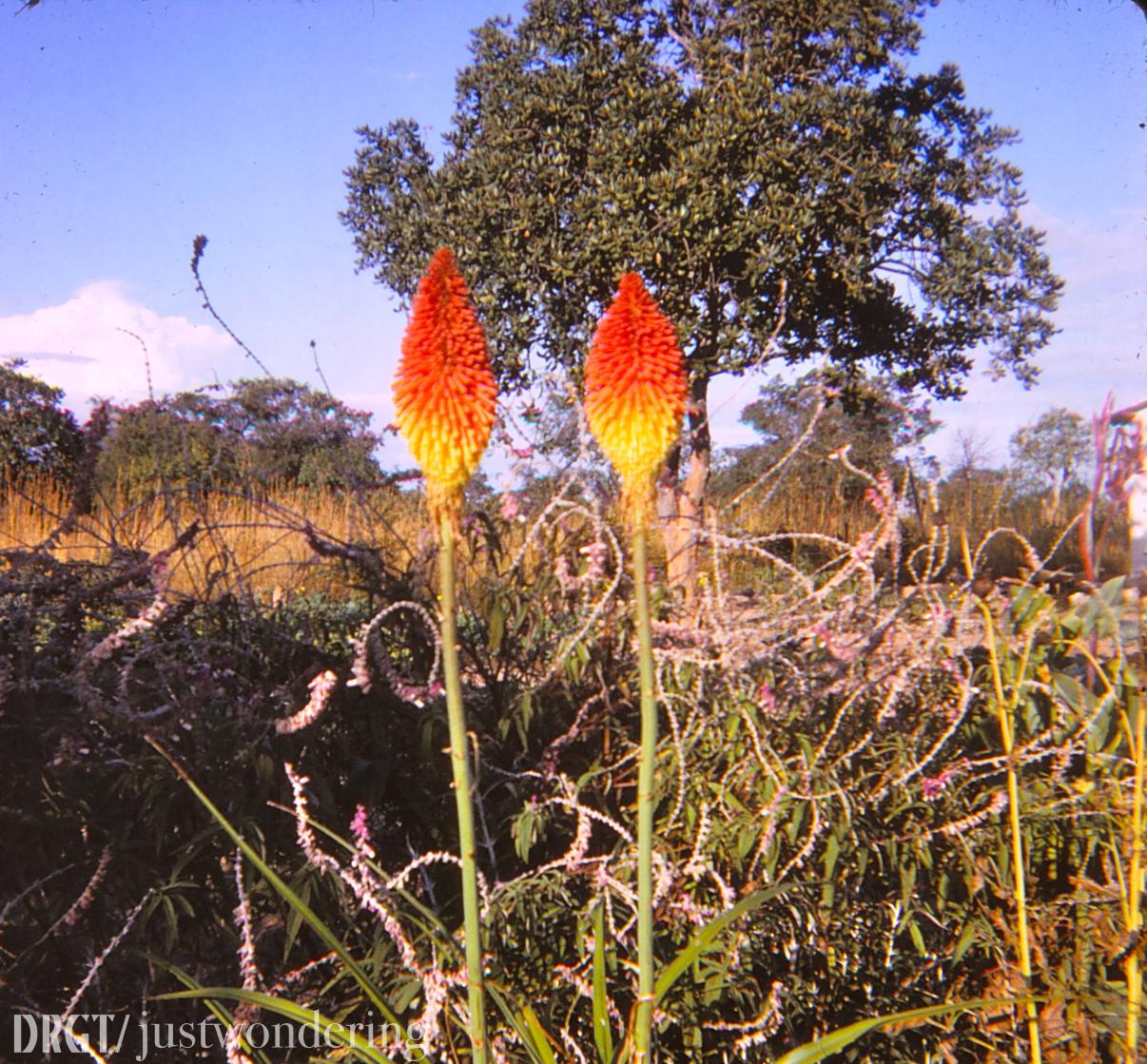
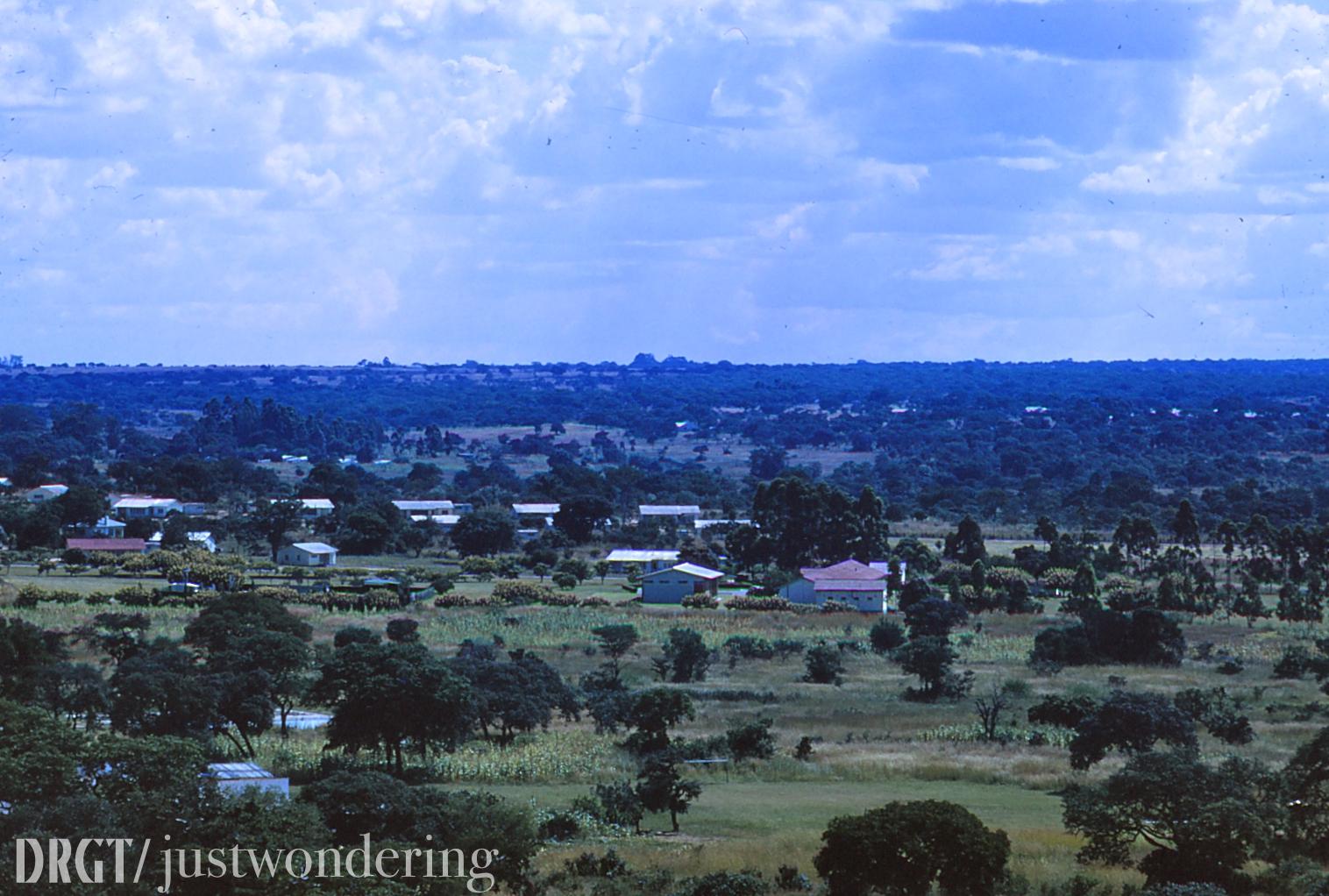
There we were, minding our own business,
getting to know this new country,
these new friends,
this new work . . .
and then the world shifted.
Well, maybe not the entire world,
just our tiny corner of it.
And it took a while to sink in, too.
On the 4th of June, 1967,
I wrote to my mom and dad and said this:
"I have been feeling lousy the last 2-3 weeks.
Attacks of nausea at odd times, extreme sleepiness
and a late period. I am going to see the doctor next week
to find out what the trouble is. Will let you know the results."
What can I say?
I was young and . . . naive?
Let's just say it . . .
I was plain old stupid about the process of reproduction.
Yes, thank you very much, I did know how it happened.
I just didn't have a clue what happened when it happened.
So . . . stupid?
Yeah, that about covers it.
My mother just laughed hysterically when she read that letter,
and her diagnosis arrived about the same time the doctor's did:
you are two months pregnant.

About four months along, sipping a Coke on the Garden Route in South Africa.
My husband's parents and younger sister came to visit us and took us on a wonderful three week trip to game parks and other beautiful places south of our home. I will write another journal entry about our travels to other parts of Africa while we lived in Zambia.

About 6 months along in these two faded black & white photos.

So. We were pregnant.
DEEP breath.
And so, the thinking and the wondering and the planning
and the gathering began.
My doctor was an American,
a member of the denomination with which we served,
and his work and his hospital were 40 miles away,
over a very, VERY bumpy dirt road, out in the bush.
I saw him three times during my pregnancy.
My everything- you-wanted-to-know-about pregnancy reading was limited,
to say the least.
A friend who was a nurse had an old ob-gyn textbook,
filled with pictures and descriptions of
all that can go wrong in pregnancy and delivery.
Lovely.

Fortunately, there were women living in our
neighborhood who had borne babies before.
In fact, over the next four months,
four other women announced that they, too, were pregnant.
It was an epidemic!
Those of us who were newbies learned from the old hands,
and somehow, we muddled through.
Our baby was due on January 9, 1968,
and I worked as a teacher through the end of the term in
mid-December, grateful for papers to grade,
students to love and exams to prepare.
We found treasures to be repaired and painted,
I created curtains out of fabric bought in our town,
friends sent me maternity clothes and baby clothes
from home, carefully folded into 9x12 envelopes.
Over the next few months,
the reality began to sink in:
we were going to be parents.
Yikes.


January 9th came and went.
January 19th came and went.
My 23rd birthday on January 23rd came and went.
I lay on the bed, weeping, convinced that I would have this oversized basketball in my body for the rest of my life.
At about 6:30 in the morning on Sunday, January 28th,
I woke up with a strong back ache.
I went into our bathroom/laundry room and
sat on the edge of the tub, folding clean towels.
I remember being overwhelmed with
the realization that my life was going to change
forever
by the end of that day.
I was, however, still stupid.
I stood in the middle of the lawn at about 9:30 a.m.,
watching my stomach ripple under my dress,
begging my cross-the-street neighbor
(who was pregnant with #4)
to tell me if this could possibly be labor.
She just looked at me and said,
"Diana, get yourself into the car and drive to Macha."

So that is exactly what we did.
If you ever find yourself wondering how you might speed things along in early labor, I have a suggestion for you.
Find yourself a very bumpy dirt road and drive on it for about an hour.
I guarantee that things will pick up nicely.
We arrived at the hospital about 10:30 in the morning, went to a very nice room with a bath and my husband proceeded to talk to me about our travel plans for the summer,
when our term of service would be ending.
I think I may have thrown the notebook in his face,
but I can't be certain.
It's all a bit of a blur.
At about 11:45, they wheeled me into the delivery room.

Only, it wasn't really a delivery delivery room,
it was a surgical suite.
The doctor was a thoracic surgeon and he did a whole lot of chest surgery out there in the bush.
They didn't have a delivery table as such,
just a surgical table,
and that sucker was hard.
His favorite nurse, who happened to be his wife,
gave me a small mask to put over my face with each
pain, a gas called Trilene.
I had no other medication.
At 12:12, just after noon on a glorious sunny summer day,
Lisa Ruth Trautwein entered the world,
a thick head of dark hair and a great set of lungs
announcing her presence.
And I distinctly remember sitting up on the table and
shouting, "This is fabulous! I want ten of these!"
As I said, stupid.
Sigh.
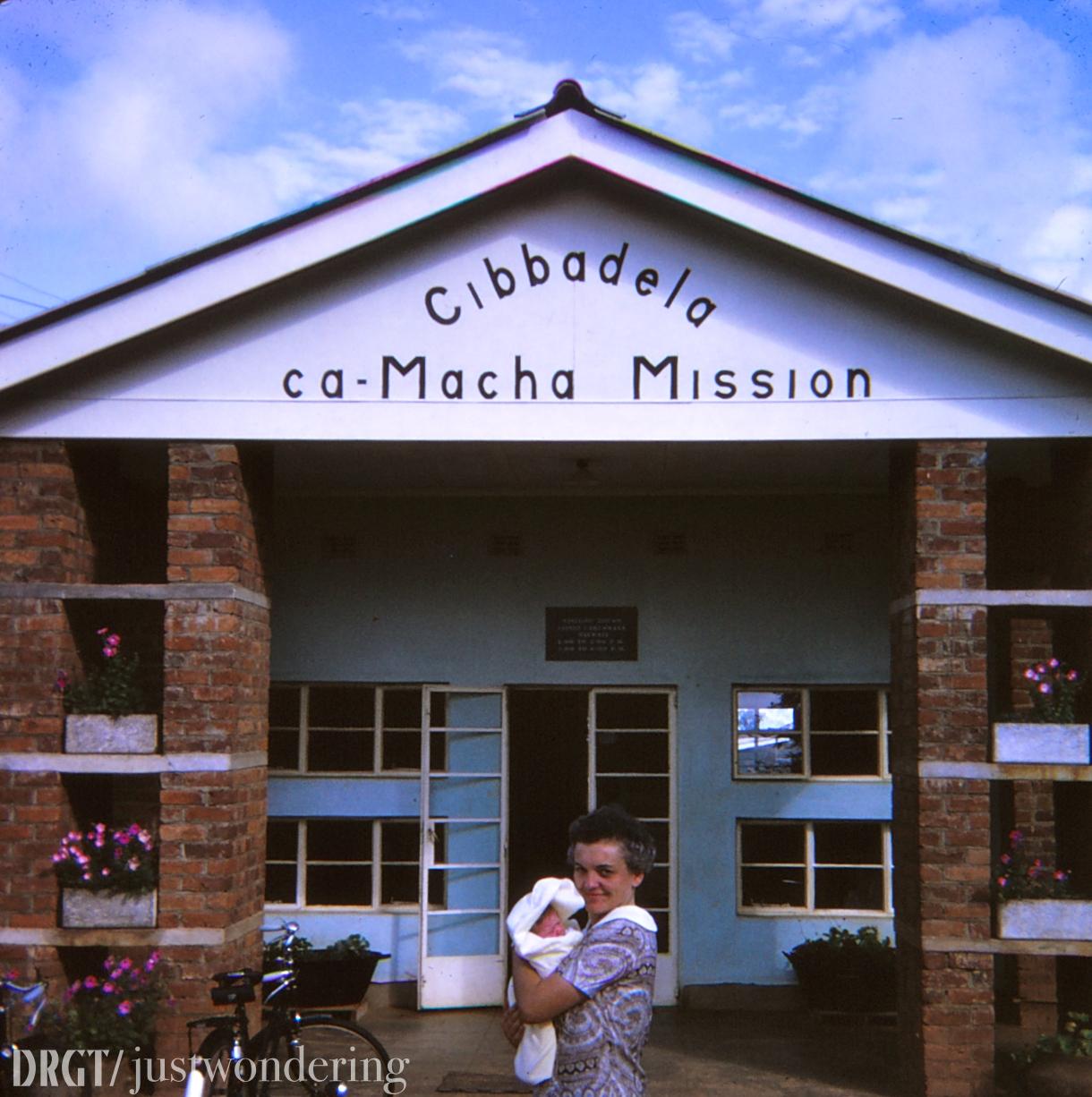
Winnie Worman, the doctor's wife and an excellent nurse, holding our 1 day old daughter.
I stayed at the Mission until Thursday, eating in their home. Dick spent the first night with us both and then returned to school on Monday morning to greet his students.

The doctor himself (Robert Worman) with our beautiful girl.

With Winnie and Lisa, outside my room. The government asked them to add 5 private rooms and I got to be in one of them. The entire birthing experience cost us about eight dollars.

We had a rocky first night.
Because my husband was with me, the nursing staff left the three of us alone that night. I very quickly learned how much I did not know about mothering,
and, once again, how much I did not know about being a woman who carries babies and gives birth.
My baby cried non-stop. Nothing would soothe her.
And I was more than a little bit weak and wobbly from very normal blood loss that scared and surprised me.
Because, as I've said . . . I was terribly uninformed . . .
Yup . . . stupid.
By 6:00 the next morning,
I greeted the nurse on duty like a super-hero of some sort. She took one look at our girl and said,
"Oh, this one loves to suck. I can see it. Try this pacifier."
Glory be! It worked. From there on, it got easier.
In the picture above, Lisa is about 22 hours old.
I'd been up, showered, shampooed, curlered and combed out, (there were no portable hair dryers in the entire country of Zambia!) and in this picture, I am figuring out how to bathe an 8 1/2 pound human person.
Fortunately, she loved it. . . and so did I.

We brought her home and introduced her to our room and to the space that would eventually be her room.
Dick and I were both ecstatic, overwhelmed with gratitude,
sometimes anxious, but basically simply delighted
to be living with this entrancing creature.
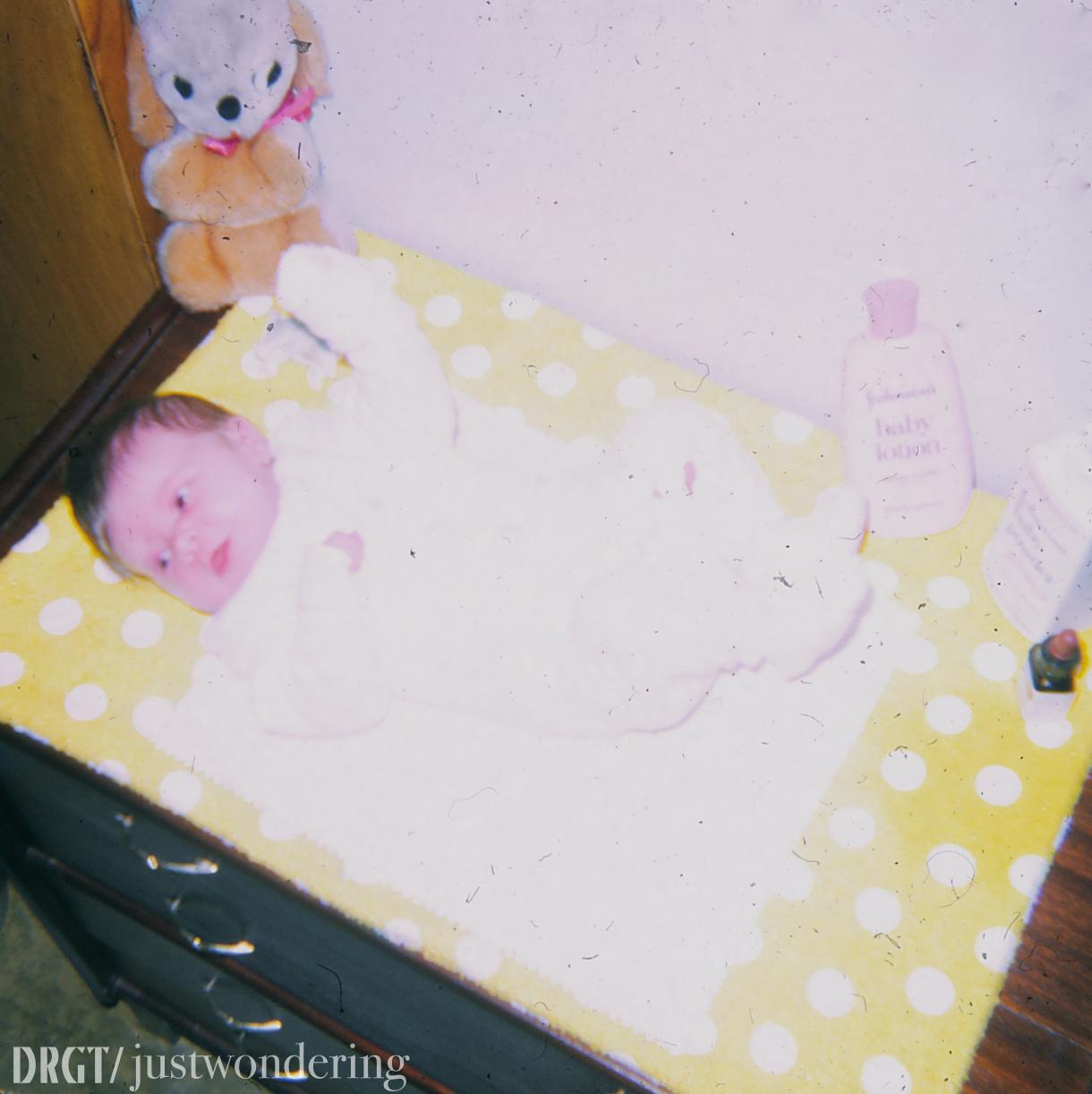


She was, of course, the most precocious child in the history of humankind, smiling at 10 days, laughing big at two months, growing blond hair with dark tips.
Our African students adored her. I think she was the only newborn baby they had ever seen who had longish, straight hair,
and they loved to touch her, to hold her, to stroke her head.

A Zambian friend loaned me her baby carrier and I used it as a pattern to make this one for Lisa and me.
There were no Ergo carriers in the 60's.
In fact, American and European parents
knew nothing about carrying babies on their bodies.
I learned about it from my African friends
and I used this sling all the time.
From the time of Lisa's birth until the time we left five and a half months later, I was called Bina Lisa by my African colleagues, most of whose first names I never really knew, as they were always called Bina ---- (insert the name of their first-born child). I have been unable to find even one picture of Lisa with our African principal and his wife or with the students who earned pocket money by helping me with my ironing twice a week. (Remember ironing??) They are among a small set of pictures that we haven't been able to locate as we've been scanning old memories into our computer. But I have strong and happy memories of their warm acceptance of our baby and of the gigantic leap of respect our becoming parents engendered in the attitude of our students toward us.

This was Lisa's favorite position, hanging upside down, sucking vigorously on that pacifier.

All five new babies near the end of our time in Zambia.
Lisa was the only girl.

Our next door neighbors, Rosemary and Harry King, holding Lisa at a staff gathering. Harry took the black and white photos you see in this and other of these African Journey posts.


The Kings were from Virginia. Millie and Dave Dyck, our neighbors on the other side - and the parents of Michael, born 2 weeks after Lisa and pictured above and below, were from Canada. He went on to become the head of the Mission Board of the Mennonite Brethren Church in that country.

Michael must have been teasing Lisa to make her pout like that.

Mom and babe on Easter Sunday, 1968. Is she not the cutest thing ever??
(Until her sister and brother were born, of course. To say nothing of all the grandkids...)

We did take a trip on the way home.
But by the time we actually left in June, that trip
had been shortened considerably.
We spent one week in Kenya, visiting some friends who were teaching there, then about 10 days in Switzerland (pictured above) and Germany, visiting my cousin and some friends from UCLA.
We were so smitten with our girl that we wanted to get her back to the arms of our loving families just as quickly as we could. And she was a great traveler, too . . . until our very last flight. From Copenhagen to Seattle, she cried almost the entire way, then settled down as we made the last leg into LAX.
That little one was just plain done with airplanes.
We were greeted at the airport by grandparents, a great grandmother and a small horde of aunts, uncles and a smattering of cousins.
It was a deliriously happy time and
I think we brought home the very best souvenir imaginable, don't you?
Becoming a mother changed me in ways that are profound,
in ways that I cannot articulate.
Carrying, birthing, nursing and tending three small persons is soul work,
down deep living-life work, sometimes terrifying, always gratifying heart-work.
Meeting Lisa was my introduction to that work
and that meeting took place a long way
from the only home I had known to that point.
There is a very real sense, however, that birthing her in that wonderful place cemented in my spirit,
my heart,
even in my body,
this truth:
home is not a geographical place
so much as it is an emotional space,
a spiritual point of connection and commitment.
All of her life, Lisa has been able to say,
"I was born in Africa."
And we have been able to say,
"Africa was our home."
And those two things go together.
I will happily join this long story with Jennifer and Duane:


And one week later, this will be my first entry in the Parent'Hood synchro blog, joining through Joy Bennett's blog: